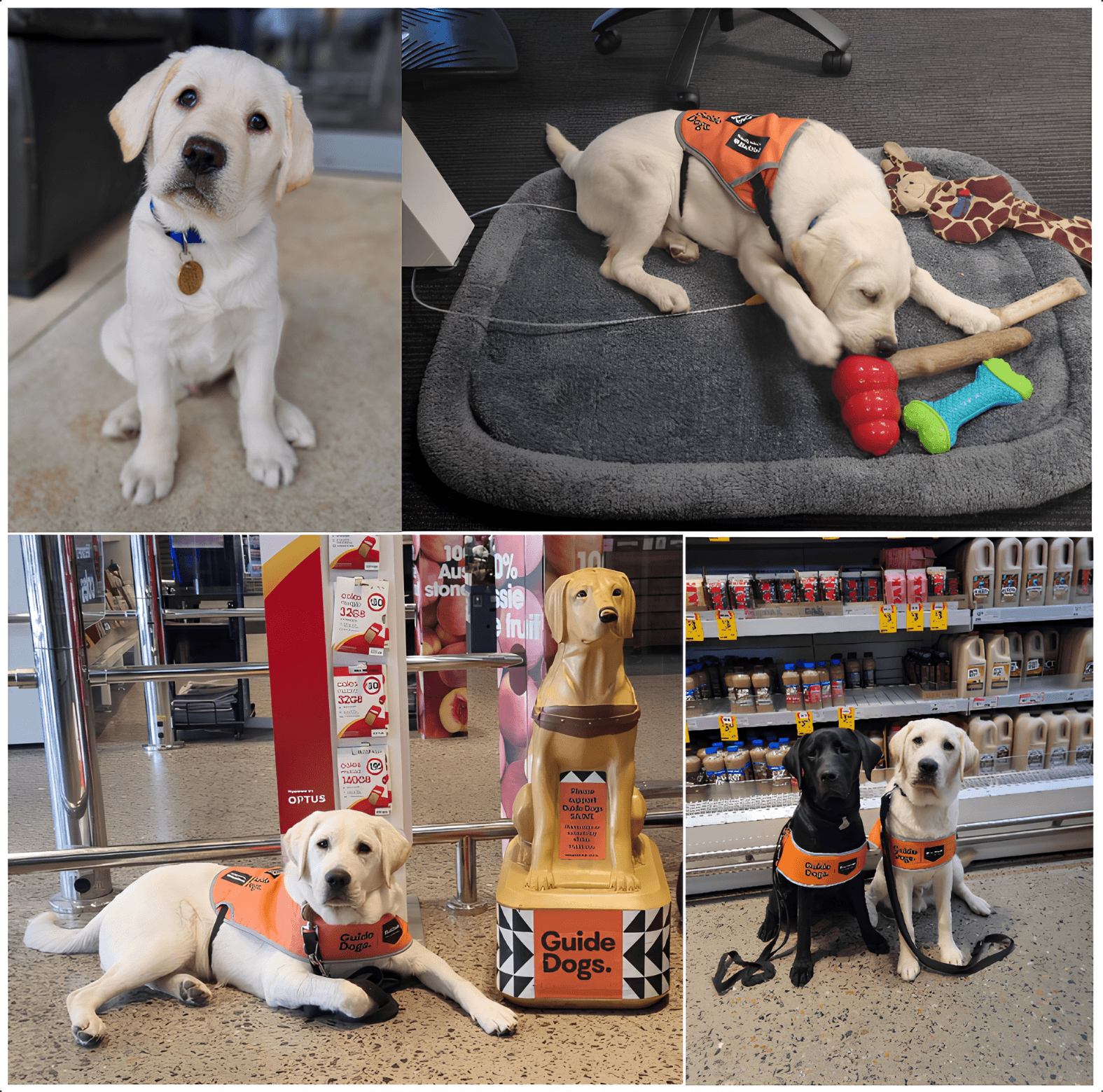
Can you imagine being handed a wiggly, bitey eight-week-old Labrador puppy and being told that you are now ultimately responsible for teaching that puppy how to successfully navigate the big, wide world so they can grow up to be a working Guide or Assistance Dog?
This is what I do as a volunteer Puppy Raiser for Guide Dogs SA/NT.
I have been a Puppy Raiser since 2023 and have raised three puppies during that time: Kipper, Violet and Dexter. Puppy raising for Guide Dogs involves welcoming a puppy into your home, providing them with the love and care they need, and teaching them basic manners and commands. As they get older, Puppy Raisers take them out to various public places such as shops, cafés, public transport and workplaces so they get exposure to all the sights and sounds they will encounter as a working Guide Dog and learn to be relaxed in these environments. We also teach them to ride in lifts and safely climb stairs.
Puppy Raisers and their pups are required to attend regular individual and group training sessions with a Guide Dogs SA/NT trainer. Puppies stay with their Puppy Raisers until around 18 months of age, after which time they begin approximately six months of intensive formal training before being matched with a client. Unfortunately, only about 20% of all puppies have the right temperament to become a working Guide Dog. Others go on to become Assistance Dogs or Facility Dogs, while others are “career changed” (which is a kind way of saying they are not suited to a working life and will go to a pet home).
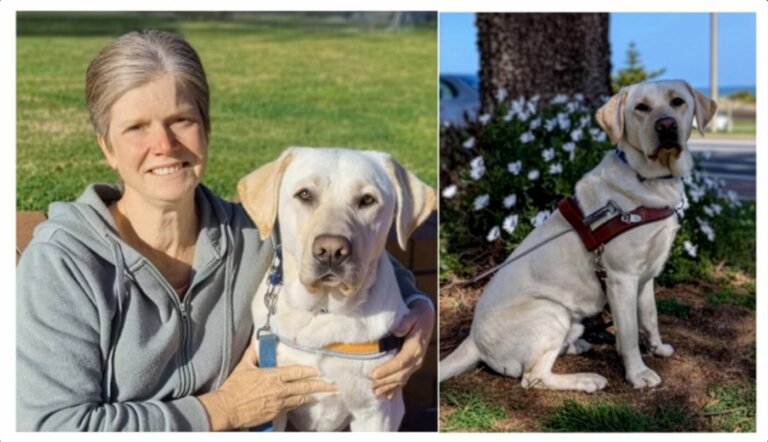
Left – My last day with Kipper. Right – Kipper in harness during his formal training.
My motivation to become a volunteer Puppy Raiser came from my previous experience over about 25 years training and competing with my own pet Labradors in various dog sports, such as agility, tracking, scent work, retrieving and tricks. I really wanted to use my skills and experience in dog training to give back to the community.
Being a Puppy Raiser has enriched my life so much. It is extremely rewarding to know that you are contributing towards helping someone with low vision live a life of independence. I always knew that Guide Dogs were highly skilled, but I now have a deeper appreciation of how amazing these dogs actually are, and what a huge impact they can have on a person’s life.
I really enjoy the challenge of training a Guide Dog puppy. They all have such different personalities, and I’ve learnt so much from teaching each and every one of them. As a consequence, I have learnt new approaches to many training challenges, which has made me a better and more rounded trainer for my own dogs. Puppy raising has also taught me immense patience, resilience and discipline.
One of the perks of puppy raising is being able to take my puppy out with me when I go places—their presence is always calming (well, as long as they aren’t being mischievous). My current puppy, Dexter, is a bit of a rockstar when we go into my workplace. Everyone in the office loves to see him, and he enjoys the pats he gets when his jacket comes off. I also value the lovely people I have met and the many friendships I have made through volunteering. The Guide Dogs SA/NT community is like a big extended family working together towards the same goal. I know they say raising a child takes a village, but the same applies to raising a Guide or Assistance Dog!
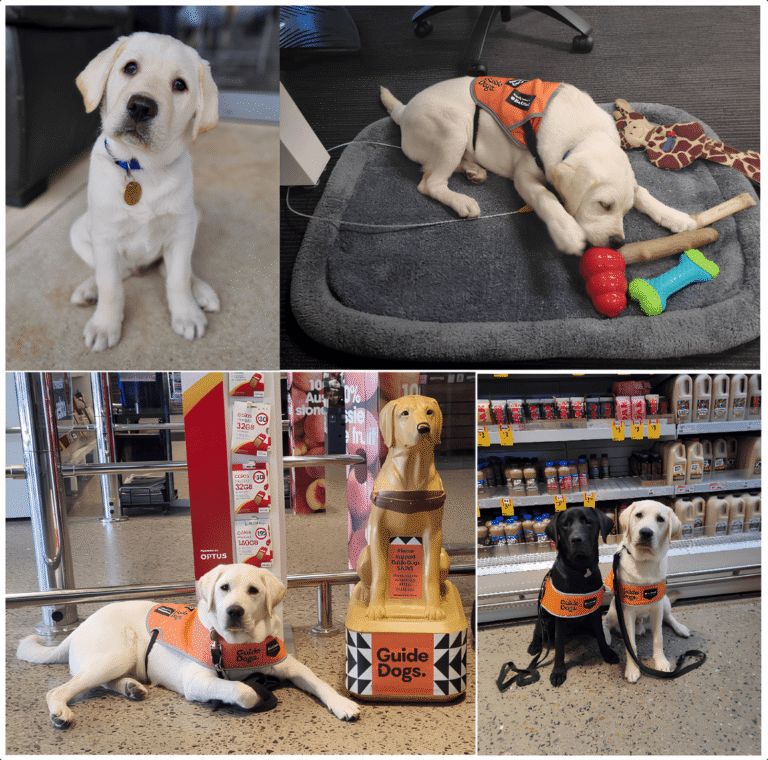
Top left – Dexter at eight weeks of age. Top right – Dexter at my workplace. Bottom – Dexter at Coles with his training buddy, Bingo.
Of course, there are sad times as a Puppy Raiser. The question most people ask is, “Is it hard to say goodbye?” The answer is always, “Yes, of course.” But you know from the start that this day will ultimately come, and you are prepared for it. It is also an exciting day because you get to see your puppy go off and successfully do the work that you raised them to do. It is hard to explain how proud this makes you feel.
I think it is harder when a puppy you raise doesn’t make it. You question whether you did enough or if you could have done anything differently.
One of my most memorable experiences from puppy raising was when my first puppy, Kipper, passed his final assessment and was accepted into Guide Dog school. It still makes me emotional thinking about it.
My second puppy, Violet, also provided lots of funny moments. She was a very sweet girl, but an absolute clown who was never cut out for a working life. Violet would express her sheer excitement at seeing another dog in the street by screaming like a banshee. This was quite embarrassing as people would turn and stare, trying to work out what creature could possibly be making this horrendous noise. It certainly wasn’t good advertising for Guide Dogs SA/NT when they saw her in her Guide Dogs training jacket! However, I am pleased to report that Violet is now living her best life on the couch as a pet dog with a family that absolutely adores her (and yes, she still screams).
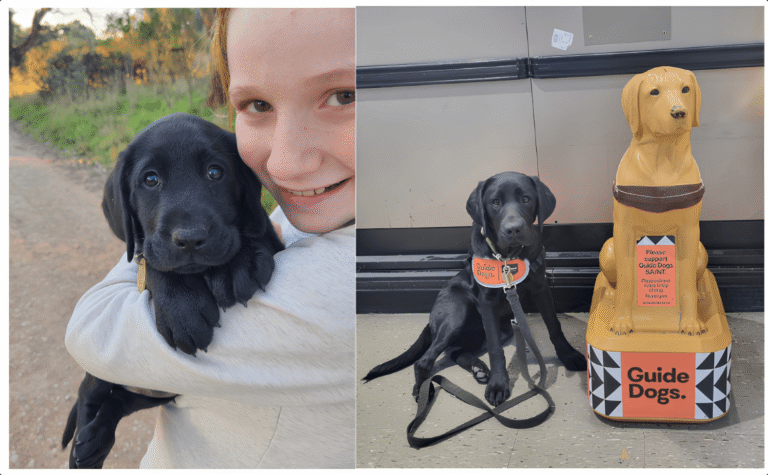
Left – Violet at eight weeks of age. Right – Violet at the shops at eight months of age.
My current puppy, Dexter, will be going for his 12-month assessment at the end of June. He certainly has the makings of a future Guide or Assistance Dog, so my hope is that he will be successful in the program and go on to have an accomplished working life. Given it costs more than $50,000 to breed, raise and train a dog like Dexter, I inevitably feel a level of pressure for him to succeed.
Once Dexter leaves our home, whatever his future holds, I will welcome another puppy, and then another puppy, because raising Guide Dog puppies is not something I think I will ever tire of doing.
Could you be our next Puppy Raiser?
If Julianne’s story has inspired you, why not consider welcoming a future Guide Dog into your home? Learn more about Puppy Raising or apply today.